logo-top-left-1v2

Asivikelane service delivery impacts counter

Impacts counter_Water icon
Water
1315
Impacts counter_Sanitation
SANITATION
1769
Impacts counter_Refuse icon
REFUSE REMOVAL
2096
Impacts counter_R&M icon
Infrastructure
191
Impacts counter_Systems icon
SYSTEMS IMPACTS
22
RESIDENT IMPACTS
10987588

Since March 2020

Sanitation website icon

Sanitation

A quarter of residents still don’t have access to a municipal provided toilet

In March 2025, we asked 5,308 residents across 202 informal settlements in 8 municipalities what type of toilet they use. Only 10% of residents have flush toilets, the remainder use self-dug pit toilets, chemical toilets, Ventilated Improved Pit toilets, porta pottis or bucket toilets.

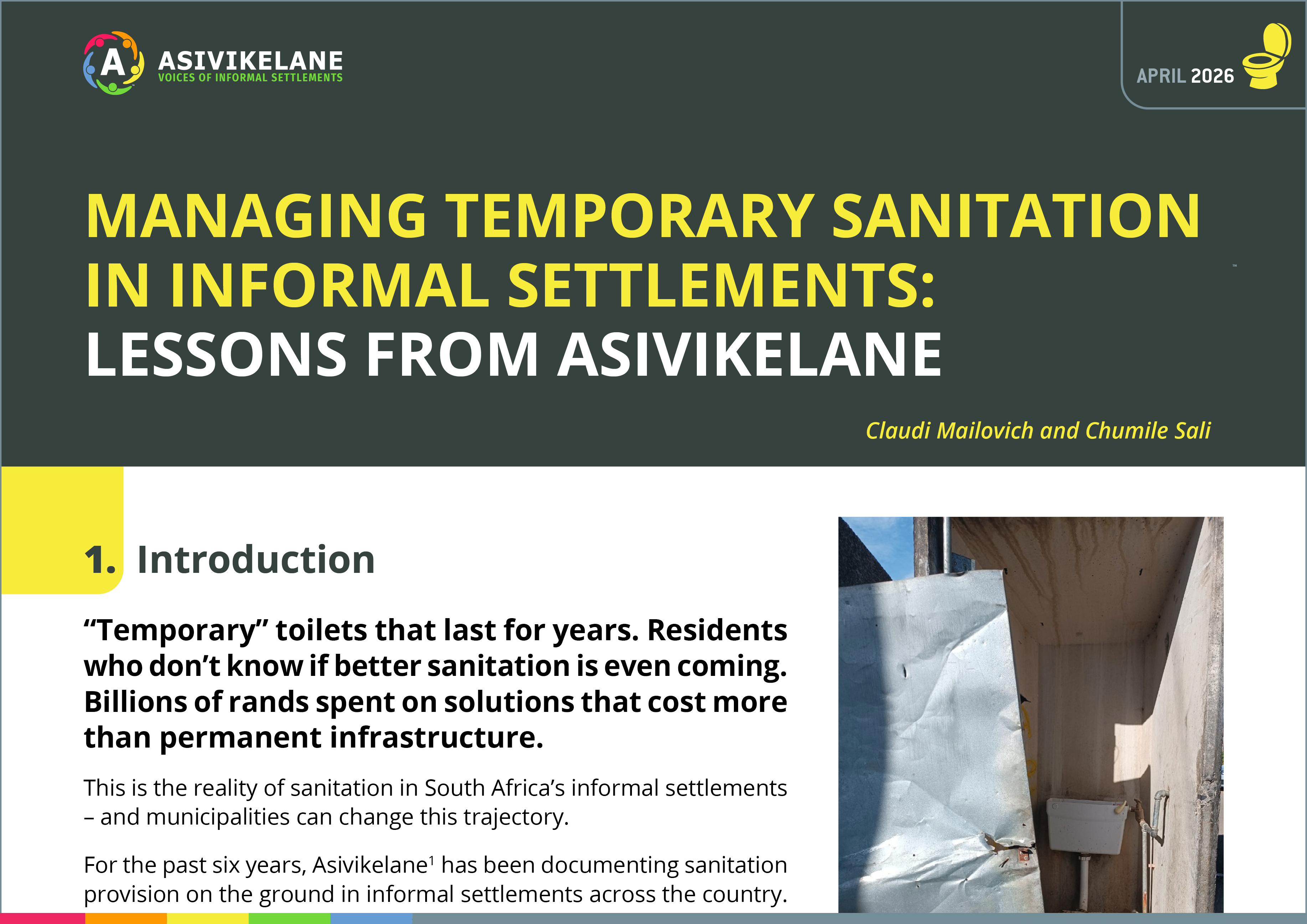
Learning paper #3 Manage temporary sanitation in informal settlements

Urban municipalities often struggle to provide permanent sanitation to informal settlements, relying on temporary solutions like chemical toilets and VIP latrines. These often face issues such as high costs, poor maintenance, and community rejection, remaining in place long-term despite their shortcomings. In our latest learning paper, Asivikelane’s insights highlight solutions to improve sanitation and address the lack of municipal planning for permanent infrastructure.

Provision of sanitation in the Mangaung Metropolitan Municipality

This detailed brief looks at the availability of communal water and sanitation services across 6 informal settlements in Mangaung and asks residents what their interim sanitation needs are.

Informal settlement taps and toilets in Buffalo City

Asivikelane mapped broken communal flush toilets, taps and standpipes across 10 informal settlements to determine the extent of damaged infrastructure. We share this information with the metro to help improve access to water and sanitation and make recommendations for fault reporting mechanisms.

Ventilated Improved Pit Toilets in informal settlements in the City of Johannesburg

Ventilated Improved Pit Toilets are a critical intervention to ensure that residents in informal settlements have access to dignified and safe sanitation. Asivikelane recommends which policies are needed to provide for the lifespan of these toilets, how to repair and maintain them and when and how they should be decommissioned.

Asivikelane WC#13 DOUBLE thumbnail

Asivikelane Western Cape #13: Knysna and Stellenbosch – Let’s make sanitation accessible to all

Asivikelane Western Cape #13 Sanitation availability has improved in Knysna and Stellenbosch. But communal toilets are not accessible to everyone, and residents urge municipalities to improve sanitation access, hygiene and safety.

asivikelane-35-thumbnail-scaled

Asivikelane #35: The state of informal settlement service delivery in metros

Asivikelane #35 Data exposes the hot spots where basic services need attention, and celebrates the good news where services have improved.

Asivikelane WC#6 DOUBLE thumbnail

Asivikelane Western Cape #6: Knysna and Stellenbosch – Who should be cleaning communal toilets?

Asivikelane Western Cape #6 calls on Knysna and Stellenbosch municipalities to step up basic services, especially the provision and cleaning of communal toilets.

asivikelane-wc8-thumbnail

Asivikelane Western Cape #8: WC residents have solutions for better sanitation. They ask government to listen

In this final Asivikelane WC report for 2021, informal settlement residents have yet again urged local government to listen and respond to their urgent pleas for safer and more hygienic sanitation. Communities are saying that they have practical, short-term solutions that are simple for government to implement; yet able to drastically improve dignified sanitation for all.

asivikelane-23-thumbnail

Asivikelane #23: Sanitation is not complicated – just ask residents

For this edition of Asivikelane #23, we ask informal settlement residents themselves what sanitation they need.