logo-top-left-1v2

Asivikelane service delivery impacts counter

Impacts counter_Water icon
Water
1403
Impacts counter_Sanitation
SANITATION
1885
Impacts counter_Refuse icon
SOLID WASTE
2236
Impacts counter_R&M icon
Infrastructure
240
Impacts counter_Systems icon
SYSTEMS IMPACTS
23
RESIDENT IMPACTS
11739088

Since March 2020

Learning 

How to improve solid waste management in informal settlements

Asivikelane worked with informal settlement residents to create a framework to improve solid waste management. These practical building blocks can help municipalities and communities to work together to improve recycling, composting and waste minimisation.

Sustainable Informal Settlement Infrastructure Summit: Building sustainable infrastructure through community-driven repairs and maintenance solutions in informal settlements

We hosted a Sustainable Informal Settlement Infrastructure Summit: bringing together a diverse range of stakeholders to foster partnerships and explore innovative solutions for dignified, sustainable access to essential basic services. The aim was to improve repairs and maintenance of water and sanitation infrastructure. The outcomes of the summit found that the future of repairs and maintenance is contingent upon empowering communities, reforming institutions, and forging resilient partnerships. The path forward must be rooted in a fundamental shift: from seeing repairs as a technical afterthought to recognising them as a cornerstone of dignity, health, and sustainable urban development.

How does Asivikelane calculate our impact?

Assessing impact in informal settlements can be challenging due to high population mobility and overlapping interventions make it difficult to attribute outcomes to a single intervention. Understanding our approach is essential to our own accountability and learning, and also strengthens our advocacy for improved basic services in informal settlements. This publication outlines our methodology and how we calculate our impact.

Learning paper: Building Sustainable Infrastructure through Community-Driven Repairs and Maintenance Solutions in Informal Settlements

Asivikelane hosted a Sustainable Informal Settlement Infrastructure Summit, aimed at improving repairs and maintenance of water and sanitation infrastructure in informal settlements. The summit brought together a diverse range of stakeholders to foster partnerships and explore innovative solutions for dignified, sustainable access to essential basic services. We’ve documented these solutions in a multi-pronged strategy, demonstrating how to build sustainable infrastructure through community-driven solutions.

A model of community-based repairs and maintenance of informal settlement water and sanitation infrastructure

Asivikelane’s community-based model for repairs and maintenance ensures that informal settlement residents are central to fixing communal infrastructure. The main idea is to train residents as plumbers so they can fix broken communal taps and toilets within their own communities. This paper outlines how this model can be replicated across municipalities.

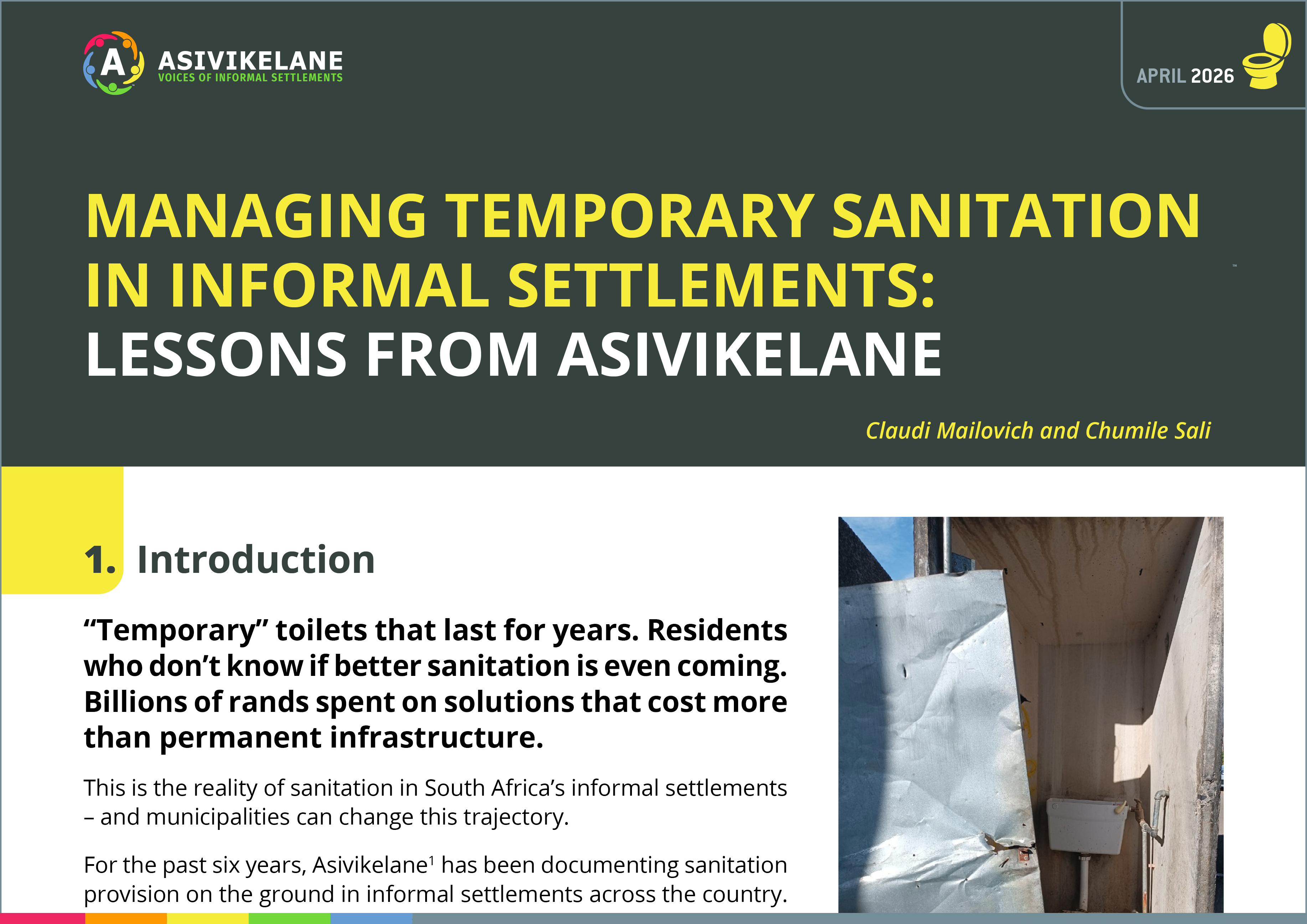
Manage temporary sanitation in informal settlements

Urban municipalities often struggle to provide permanent sanitation to informal settlements, relying on temporary solutions like chemical toilets and VIP latrines. These often face issues such as high costs, poor maintenance, and community rejection, remaining in place long-term despite their shortcomings. In our latest learning paper, Asivikelane’s insights highlight solutions to improve sanitation and address the lack of municipal planning for permanent infrastructure.

Knysna. Small fixes, big impacts

We take a look at how municipalities can integrate community plumbers and enhance fault reporting for efficient community repairs of communal services.

Learning Adventures 1 (landscape) by

Cracking the code: identifying the underlying causes of service delivery problems

Join us on our first learning adventure as we unpack and identify the underlying causes of service delivery problems. In this publication, we look at waste removal and the reasons litter and garbage pile up in informal settlements. This series records what we’ve learned, so that we don’t forget and make the same mistakes again, and so that others can learn from our mistakes too.